Stop, Start, Scale: How to Turn Up the Volume on What Already Works in Your Travel Business
 Joshua Harrell
8 min read

Most travel advisors don’t need a new idea. They need to repeat an old one.
Think about the last time something worked in your business. A post that got people messaging you. An offer that filled. An email that made your phone buzz. What did you do next? If you’re like many advisors, you moved on and went looking for the next thing, while the thing that was already working sat there waiting for you to come back.
This is Step 5 of the Thriving Travel Advisor Blueprint: Turn Up the Volume. It doesn’t mean doing more of everything. It means finding the one song that’s working and turning that song up, not the whole playlist. You’ll do it with three decisions: one thing to stop, one small experiment to start, and one proven activity to scale.
Why Advisors Walk Away From What Works
It isn’t laziness, and it isn’t bad marketing. It usually comes down to three things.
- You get bored before your audience does. You’ve written, edited, posted, and reread that post forty times. Your audience saw it once, maybe.
- Nobody told you it was working. If you don’t track where leads come from, a winner looks exactly like everything else you do.
- New feels like progress. Starting something gives you a little rush. Repeating something feels like standing still. But in a travel business, repeating what works is how you actually move.
Decision One: Stop
Start with an honest inventory. List every marketing activity you’re doing right now: every platform, newsletter, group, and networking breakfast. For many advisors the list runs to five, six, or seven items. Nobody decides to do seven things. You add one at a time, and you just never take anything off.
For each activity, write down five things:
- Activity
- Time per week
- Last real lead. Not the last like or nice comment. The last time someone came from it and asked about a trip. “I don’t know” is a useful answer.
- Effort, 1–5. A 1 is something you could do half asleep. A 5 takes a big chunk of your week, or it’s something you dread. Dread counts.
- Result, 1–5. A 1 means you can’t point to a single inquiry. A 5 means it’s one of the main places clients come from.
Here’s what a filled-in list often looks like:
| Activity | Time per week | Last real lead | Effort | Result |
|---|---|---|---|---|
| 3 hours | Two months ago | 4 | 2 | |
| Monthly email to past clients | 1 hour | Last week | 2 | 5 |
| Local networking breakfast | 2 hours every other week, counting the drive | I don’t know | 3 | 1 |
| Supplier co-op posts | 30 minutes | Never | 1 | 1 |
The email is barely any work, and it’s carrying the business. The breakfast is real effort, and nothing comes back. Your stop candidate is the activity with the highest effort and the lowest result, not just the lowest result. The co-op posts aren’t bringing anything in, but at thirty minutes a week they aren’t what’s draining you.
Consider a composite advisor we’ll call Marcus, who plans family trips to Banff and the Canadian Rockies. He spent about five hours a week designing beautiful Pinterest pins. When he filled in his inventory, he couldn’t find a single inquiry from Pinterest in ninety days. Meanwhile, his monthly email to past families took about an hour and had brought in four new trips that season. Five hours a week is about twenty hours a month, a part-time job that wasn’t bringing in one client. When Marcus stopped, he didn’t lose anything. He got twenty hours back.
A few things make stopping easier:
- Name the guilt. Write down what you’ll feel guilty about and why it’s okay anyway. You built that thing, and maybe someone told you every advisor has to be there. Your inventory tells you what’s true for you.
- Pause instead of delete. Leave the account up and pin a last post that points people to your email list. Then check back in ninety days. If nobody noticed, you have your answer.
- Stop the version that costs too much. Sometimes the fix is posting twice a week instead of five times, and only posting what has ever started a conversation.
You do not have to keep doing something just because you started it. That isn’t quitting. That’s data.
Decision Two: Start
Before you add anything new, answer three questions:
- What’s your most-booked trip type?
- Which channel brings you most of your leads?
- What kind of content does your audience respond to?
Your next experiment should grow out of those answers, not distract from them. If your best leads come from your email list, your next experiment shouldn’t be a brand-new platform. It should make your email list work even harder. An advisor who books Costa Rica family trips mostly through referrals might send past families three photos and one line: “Know anyone who’d love this?” An advisor who specializes in Scotland and Ireland, and whose list loves her packing lists, might offer an Ireland first-timer checklist to her list and her followers.
Every experiment should pass three tests:
- It’s small. It fits inside the hours your stop decision gave back.
- It’s close. It grows out of your trip type, your channel, or your best content. If it needs a new audience, a new platform, and a new skill, it’s a new business.
- It’s countable. Give it a thirty-day window and a success number you can actually count: three discovery calls, fifty new subscribers, or two deposits. Engagement isn’t a success number, and neither is “see how it goes.” If you can’t count it, you’ll keep doing it forever, just in case.
When the thirty days end, make one of three calls. Keep it if it hit the number. Tweak it if it got real interest but missed, and change only one thing (the price, the subject line, or the date). Drop it if it missed by a mile, and you’ve still learned something in thirty days instead of a year.
Then pick one experiment, not three. Three at once is just a new way to be busy, and if something works, you won’t know which one did it. To keep it from stalling in week one, use AI to draft the first month of posts or messages, then edit them until they sound like you. If a line sounds like a brochure, rewrite it the way you’d say it to someone you love who isn’t plugged into your day-to-day.
Decision Three: Scale
Don’t scale everything. Scale the winner: the activity bringing in the most leads or bookings right now. Not the one you wish was working, and not the one you’re proudest of. The one with the receipts.
Proof is a direction, not a suggestion. Picture an advisor who posted a three-part carousel series on choosing a Greek island. Eleven people messaged her, four booked, and then she moved on to a new platform. Scaling meant bringing the series back with two new islands each month. When something works, you don’t retire it. You give it a sequel.
There are four dials you can turn. Pick one:
- Frequency. Do it more often. The monthly email becomes twice a month.
- Reach. Send more people into it. A river cruise specialist with a three-email welcome series that books one call for every eight readers needs more doors pointing to it: a link in every post, a mention on every call, a line in the email signature.
- Format. Serve what works in a new way. The carousel becomes a short email series, and the email becomes a sixty-second video.
- Offer. Add capacity to something that sells. The departure that filled gets a second date.
Then write a ninety-day plan with one action, one measure, and one target per month. If your scale candidate is your past-client email, month one might be going from one email a month to two (target: three calls). Month two adds a referral line to every email (target: two new names). Month three adds a new signup source, like a link in your social bios (target: forty subscribers). Leave the second scale candidate blank unless you have real capacity.
One caution before you stop anything: ask your last few clients how they first heard about you. An activity with no recent leads can still be building trust that turns into bookings a year later.
Write It Down in Three Sentences
Finish with a commitment you can read in ten seconds:
- I will stop __, effective ____.
- I will experiment with ______ for thirty days.
- I will scale __ by ____.
Then add one action you’ll take in the next seven days. Watch for three traps. Around week two, something new and shiny will show up, so put it on a list called “later.” The activity you stopped will call you back, so reread why it’s okay. And when you scale, the first month can look flat. That’s normal, which is why the plan is ninety days, not nine.
The advisors who grow year after year aren’t chasing every new idea. They’re running the same plays a little better every season. From the outside, it looks boring. From the inside, it looks like a full calendar.
Get the Decision Sheet
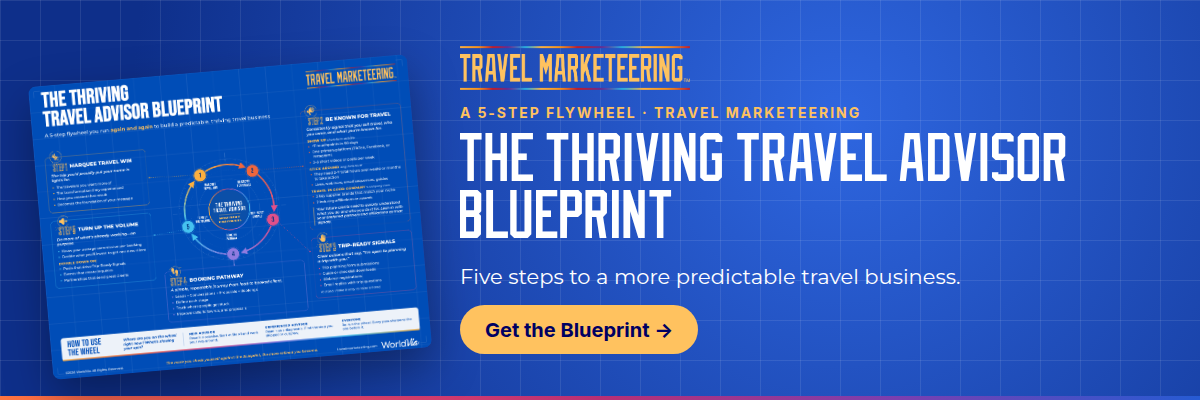
Download the Stop / Start / Scale Decision Sheet to work through your inventory, experiment, and ninety-day plan on paper. If you’re new to the framework, get the free Thriving Travel Advisor Blueprint, the five-step plan behind this lesson.
Watch the full Travel Marketeering Live episode, including a round of Stop, Start, or Scale with advisors selling Mauritius honeymoons, river cruises, and Alaska. Prefer to listen? Find Travel Marketeering with Joshua Harrell on any major podcast platform.