.png?width=260&height=84&name=WORLDVIA%20TQN%20COMBO%20LOGO%20(1).png "WorldVia Travel Network Logo")
.png?width=155&height=50&name=WORLDVIA%20TQN%20COMBO%20LOGO%20(1).png "World Via Travel Network")
How to Write a Travel Advisor Brand Voice That Sounds Like a Person, Not a Brochure
.jpg?width=32&height=32&name=worldvia%20dec25-44%20(2).jpg)

There is a specific test I run when I open a travel advisor's website. I read the first paragraph out loud, and I listen for whether it sounds like something a human being would ever actually say. Most of the time it does not. It sounds like a document. "Welcome to [Agency Name], where we curate bespoke journeys tailored to your unique vision." Nobody talks like that at a dinner party. Nobody talks like that on the phone with their sister-in-law. Yet it is the register most advisors default to the moment they sit down to write about themselves.
Brand voice is not a font choice or a color palette. It is the version of you that a stranger reads at midnight, deciding whether to fill out your contact form. If they cannot hear a person on the page, they will not write to one.
What is actually broken in an advisor brand voice
The problem is almost never talent. Every advisor I know is warm, funny, and precise in conversation. The problem is a translation error that happens between speaking and writing. When we speak, we relax our syntax, we use contractions, we make small jokes, we admit uncertainty. When we write, we straighten our posture and start using words we would never use out loud—"curated," "bespoke," "seamless," "elevate." Those words are the tell. A recurring complaint I have watched surface on advisor forums for years is that every travel advisor website sounds like the same website, because everyone borrows the same set of ten adjectives from each other.
Read ten advisor websites back to back and most of them could be swapped without anyone noticing. Very little of the language could be attributed to one specific advisor over any other. That is not a design problem. That is a voice problem.
The voice memo trick that beats a whole strategy doc
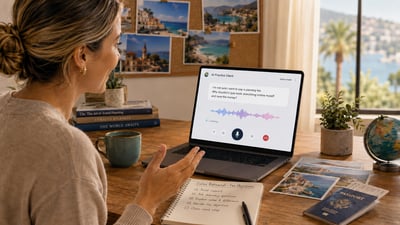
Try this before you hire a brand strategist. Open your phone, hit record on a voice memo, and answer the question "why did I actually become a travel advisor?" out loud, for four minutes, like you are talking to a friend. Do not script it. Do not edit. Just talk.
Then transcribe it. Most phones will do this automatically now. What you will find in that transcript is your actual voice—the rhythms you use, the way you build up to a point, the specific words that are yours. Underline the phrases that feel like you and cross out anything that sounds like you were trying to impress someone. That underlined material is the raw seed of your brand voice. Not the strategy deck. The transcript.
An agency owner in our network did this exercise, took the three most repeated phrases from her transcript, and rewrote her homepage around them. Her inquiry conversion doubled inside a quarter. Same photos. Same services. Different sentences.
Five specific words to retire before Monday
There are five words that appear on so many advisor websites they have functionally lost their meaning: curated, bespoke, seamless, elevate, and unforgettable. If you use any of them, you are hiding inside a category costume. Replace each with the specific thing you actually mean.
"Curated" often means "I have been there and I choose carefully." Say that. "Bespoke" often means "I design each itinerary from scratch." Say that. "Seamless" usually means "I answer the phone when something goes sideways." Say that. When you replace category words with concrete specific language, your voice starts to reappear on the page. This is Mottainai in language form—do not waste the specific words you already have available by burying them under generic ones.
Where the voice actually shows up—and where it does not
Voice is not evenly distributed on your website. It lives in three specific places. Your homepage first paragraph. Your about page. And, most underrated, your inquiry auto-responder. Those three surfaces do 80 percent of the trust-building work before a client ever gets on a call with you.
The about page especially is where advisors flatten themselves into a resume. It should not be a resume. It should be a story with two or three specific moments in it. The trip your parents took you on when you were nine. The client whose honeymoon you almost missed a flight for. The reason you left the corporate job. A recent industry survey found that visitors spend 2 to 3 times longer on advisor about pages that contain a specific personal anecdote versus those that read like a bio. Longer time on page is not vanity—it is the moment a stranger decides you are a person they want to work with.
The permission to sound like yourself, everywhere
Once you have the voice on your website, use the same voice on Instagram, in your emails, in your newsletter subject lines, in your voicemail greeting. Not a stiffer version for email and a looser version for social. One voice, consistent, everywhere. Wabi Sabi lives here—your voice will have imperfections and small quirks, and those are precisely the things that make you findable and memorable. A polished voice is forgettable. A slightly imperfect one is human.
If you have been putting off a brand voice project because it felt like something a big agency has to do, consider a smaller starting move. Record the four-minute voice memo. Read your homepage out loud tomorrow morning. Ask yourself whether the person on the page and the person holding the phone are recognizably the same person. What would change if the first paragraph of your website sounded exactly like you at a dinner party?





.png?width=500&height=500&name=Untitled%20design%20(28).png)